Manure Belt on an H-Type Layer Cage
- A manure belt sits under each tier of an H-type layer cage. Droppings land on it and leave at the row end.
- The belt is polypropylene, commonly 1.0 mm up to about 100 m of row, 1.2 mm on a longer or wetter row.
- An A-type row usually takes a scraper in a pit, not a belt. The two are not interchangeable.
Stacked cages cannot drop manure through the birds below. Weifang Splendid fits a belt under each tier of an H-type layer row, with a scraper at the drive end and a cross conveyor out of the house. The belt is the surface. The scraper only cleans that surface. It is not the floor scraper used under an A-type.

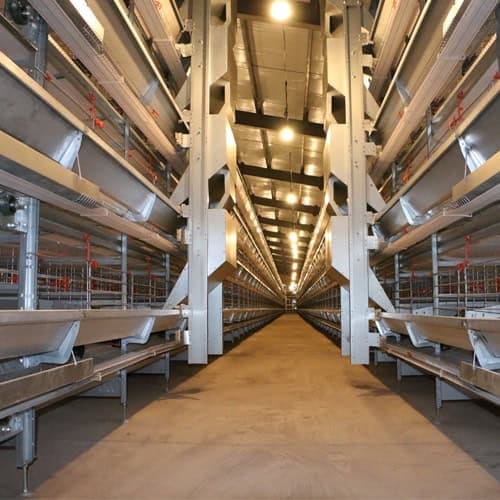
Where the belt sits
Each tier has its own loop. Width follows the cage, not a stock roll. Length follows the row. At the drive end a roller turns the belt, a blade takes the manure off, and a cross conveyor or auger carries the combined rows outside. The return run goes back empty under the cages. Limit switches and the house controller stop the cycle. Run it on a schedule. Leaving a full belt overnight is how ammonia builds, not how a belt fails on day one.
The belt does not clear ammonia by itself. It shortens the time manure sits in the house. Ventilation, drinkers that do not leak onto the belt, and a scraper that actually touches the belt still decide the air. A wet belt from a leaking nipple line is a drinker problem. The belt only carries what lands on it.
Belt or scraper
H-type is the belt job. Tiers stack in a vertical line, so each level needs a catch surface. A-type steps outward. Manure can fall to a pit, and a scraper walks that pit. Putting a belt quote on an A-type row, or a scraper quote on an H-type row, is the mismatch that shows up at install. Some older A-type frames were later fitted with belts. That is a rebuild, not the standard line.
| Belt | Scraper | |
|---|---|---|
| Cage | H-type, one loop a tier | A-type, pit under the row |
| Surface | PP belt, 1.0 or 1.2 mm | Blade on a pit floor |
| Leaves by | Scraper at the roller, then cross conveyor | Blade to the pit end |
| Watch | Tracking, scraper pressure, wet spots | Pit depth, blade wear, corners |
What wears it
Polypropylene is the usual belt. It takes uric acid better than a soft PVC that stretches. Thickness follows length. About 1.0 mm covers a standard row up to around 100 m. A longer row, or a breeder row with wetter manure, moves to 1.2 mm. Those are shop ranges, confirmed on the row length you send. The blade at the roller should meet the belt evenly. Too light and manure rides back. Too hard and the belt grooves. Side wander comes from a roller out of square or a load heavier on one edge, often a leaking drinker over one tier.
What to send
H-type or A-type, tiers, row length, cage width, layers or breeders. Weifang Splendid marks belt width and thickness from the row, and the cross conveyor from how many rows share one house end.
FAQ
Does an H-type cage use a manure belt?
Yes. One belt under each tier. An A-type row usually takes a scraper in a pit.
How thick is the belt?
Commonly 1.0 mm to about 100 m of row, 1.2 mm on a longer or wetter row. Confirmed on the drawing.
Does the belt remove ammonia?
It shortens the time manure sits in the house. Ventilation and dry drinkers still decide the air.
What should I send?
Cage type, tiers, row length, cage width, layers or breeders.