Nest Boxes for a Floor House: One Row or Two
- A nest box in a floor house is a community unit, not one hole per hen. Count sets from birds and from house length.
- Automatic: one centre row, egg belt to one end. About 160 birds a set. An 8,000-bird house takes about 50 sets.
- Manual: a 2 m aisle, a row each side, one set every 3 m. About 96 birds a set. The same house takes about 80 sets.
Floor layers and floor breeders lay in a nest. Cage houses do not use this line. Weifang Splendid builds the automatic set with a belt and the manual set for a walked aisle. The choice is how the egg leaves the house, then how many sets the length will hold.
Two ways the egg leaves
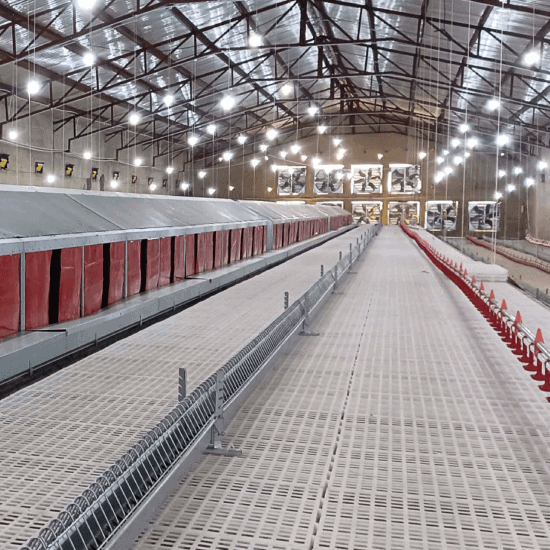
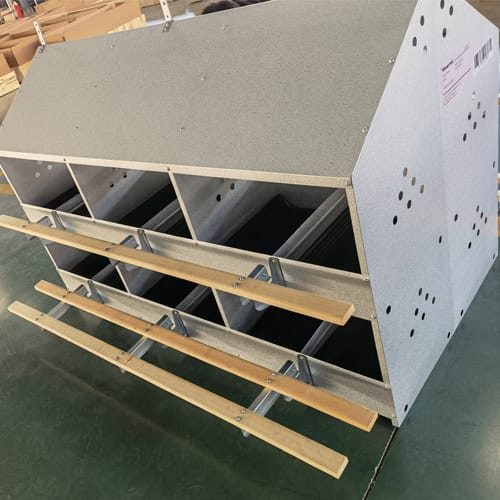
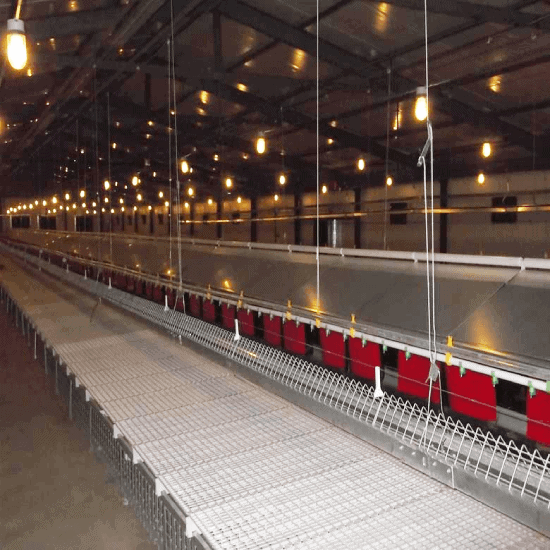
An automatic set is a large shared nest. The egg rolls off the mat onto a belt and rides to a table at one end. Staff do not walk the row at lay time. A manual set is collected by hand. Someone walks the aisle, often more than once in the morning peak. The belt saves that walk. The manual row is simpler and needs no belt drive, and it needs the aisle kept clear.
Both are hot-dip galvanized sheet, zinc 275 g/m², 0.5 mm. That coat is what stands up in a wet house. The automatic set is 2,000 × 1,060 × 580 mm and is rated about 160 birds. The manual set is 1,500 × 1,070 × 970 mm and is rated about 96 birds. Those are the working sizes. A house with a different length changes the set count, not the size of the box.
An 8,000-bird house
Eight thousand birds on the automatic line is one centre row, about 50 sets. The count from length is (house length in metres − 5) ÷ 2. The 5 m is the two ends: collection table, drive, and the turn the belt needs. Fifty sets is 100 m of nest plus those ends, so the house that fits this row is on the order of 105 m. Shorter house, fewer sets, and the birds per set go up. That is the limit to watch, not a second row squeezed in.
The same 8,000 birds on manual nests take about 80 sets. The aisle is 2 m down the middle. A row sits each side. Sets go every 3 m, about 40 a side. Eighty sets at 96 birds is a little over the flock, which is the margin. A 3 m gap is what lets a collector reach both faces without climbing the slats. Close that gap and the aisle stops working as an aisle.
| Automatic | Manual | |
|---|---|---|
| Set size | 2,000 × 1,060 × 580 mm | 1,500 × 1,070 × 970 mm |
| Birds a set | about 160 | about 96 |
| 8,000 birds | about 50 sets, one centre row | about 80 sets, two rows |
| How it sits | (length − 5) ÷ 2 | 2 m aisle, one set every 3 m |
| Egg leaves by | Belt to one end | Hand, from the aisle |
What else decides the row
The nest has to be the place a hen chooses. A shared set still needs a perch she can step from, and that perch should not be the highest roost in the house or she sleeps there. On an automatic line the belt end needs a clear collection point and a drive the length can pull. Mats come out for wash-down. On a manual line the 2 m aisle is also the path for the egg tray. Block it with a feeder loop and collection slows on the morning peak.
Breeders on the floor use the same boxes, with males in the house. The centre aisle should not become the only place males stand, or hens queue. A drinker line that keeps males off the nest face is part of the layout, not an extra. Floor eggs rise when sets are short, the step is high, or the row sits in a draft. The fix is sets and placement, not a brighter lamp in the nest. Nests are kept dimmer than the scratch area so the hen goes in.
What to send
Birds, layers or breeders, house length and width, and whether eggs go out on a belt or by hand. Weifang Splendid marks set count from those, then the row.
FAQ
How many automatic nest sets for 8,000 birds?
About 50, one centre row. Count from length is (metres − 5) ÷ 2.
How many manual sets for the same house?
About 80. Two rows, a 2 m aisle, one set every 3 m.
Do cage houses use these boxes?
No. These sets are for floor layers and floor breeders.
What should I send?
Birds, layers or breeders, house length and width, belt or hand collection.
Send house length and how the egg leaves.
Birds, layers or breeders, belt or hand.