Layer Cage Houses: How Eggs Leave One End and Manure Leaves the Other
A commercial battery cage system is a house with two exits. Feed and water run the length of the row. Eggs leave at the collection end. Manure leaves under the cages or at the scraper pit. If either exit is missing, staff walk every tier.
- Layer cages earn their keep when those two exits stay open every day, not when the photo looks like a catalog.
- A-type and H-type both need a planned egg end and a planned manure end. The shell height and aisle change; the two exits do not.
- Name the country before steel is cut. Some destinations will not accept a conventional cage. This page is not legal advice.
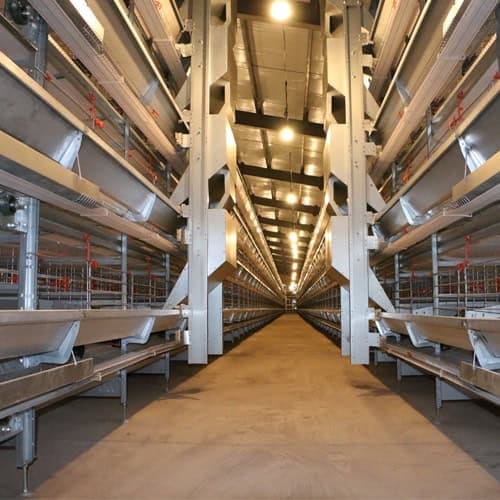
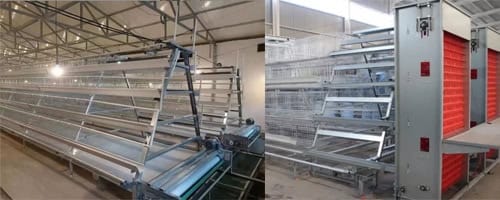
Cage farming for table eggs is a materials-handling job. Birds sit in rows. The line has to move three things without a person carrying them: mash, eggs, droppings. That is the working meaning of a battery on a commercial farm — a bank of chicken layer cages sharing those paths.

Two ends of the house
Stand at the door and name the ends before you count tiers. One gable or side wall is where eggs should arrive — a belt head, a packing table, or trays that can be lifted without climbing the stack. The other service is manure: a belt dump, a scraper channel, or a pit that can be emptied without soaking the pads. Mix those two jobs on the same platform and you get dirty eggs and wet concrete.
| House job | What the cage line must provide | What fails if it is missing |
|---|---|---|
| Egg end | Belt or tray path to one packing point | People on every tier, cracked and dirty eggs |
| Manure end | Belt, scraper or a pit that can be emptied on a clock | Ammonia, wet pads, flies |
| Feed and water along the row | Trough or chain plus nipples that can be raised | Uneven crops, drop in lay |
| Air across the stack | Fans and inlets sized to the top tier, not only floor area | Heat on the upper cages first |
Work the line is supposed to take off the crew
A cage house is not “set and forget.” It is “walk less.” Collection and manure are the two jobs that explode headcount when the exits are manual. Drinker height after each raise, a belt that actually runs, and a light clock that survives a power cut are the daily list. Vaccines stay with the veterinarian.

| Daily job | On a working battery | When the line is incomplete |
|---|---|---|
| Pick eggs | At the belt head or tray table | Every door, every tier |
| Move manure | Belt or scraper on an interval | Shovels under the row |
| Check water | One walk after a height change | Dry nipples found after lay drops |
| Cull and inspect | Aisle at bird height, including the top tier | Only the cages by the door get seen |
Meat cages and layer cages do not share an egg end. A broiler stack has no belt for table eggs. Do not hang a layer battery in a grow-out house and expect collection to appear.
What the farm must have ready before the container
Level floor, power for belts and fans, a water line that can be dosed, and a place for manure to go after it leaves the house. H-type needs eave height for the top walk. A-type needs width for the stepped rows. Those two frames are specified on the equipment page; this page only flags that the building has to match the exits.
Destination country belongs on the same list as hen numbers. Conventional cages are restricted in some markets. Weifang Splendid draws the cage type the buyer names. Do not treat a blog as a statute.
FAQ
What does a battery cage system do in a working house?
It keeps hens in rows that share feed, water, an egg path and a manure path. Without the two exits, it is only wire.
Do A-type and H-type need different house ends?
Both need an egg end and a manure end. H-type usually needs more height. A-type usually needs more width. Pick the frame on the equipment page; size the shell here.
Can broiler cages run table eggs?
No. Broiler cages have no layer egg belt, and they are not sold as A-type.
What do I send to size the line?
Country, hen numbers, house length, width and eave height, and whether manure can leave on a belt or must sit in a pit.
Send the house ends, not only the bird count.
Length, width, eave height, climate or country, hens. Weifang Splendid will set one layer-cage line to those two exits.