Complete Poultry Farming Business Plan: Key Components, Sample Guide & How to Address Common Challenges
Key Takeaways
- Core Structural Pillars: A robust poultry farming business plan integrates executive summaries, market forecasts, and precise equipment specifications.
- Hardware Integration: Deploying vertical H-type or A-type layer cage systems maximizes space utilization and optimizes automated workflows.
- Risk Mitigation: Controlling 65%–70% feed expenses and enhancing biosecurity through automatic feeding and manure removal systems.
Drafting a comprehensive poultry farming business plan is the definitive first step for investors entering the commercial agricultural sector. Whether you are managing a large-scale poultry farming project or securing institutional financing for a new enterprise, mastering operational frameworks and advanced poultry farming equipment specifications dictates your long-term profitability.
Modern commercial chicken production requires rigorous financial budgeting and strict biosecurity architecture to protect profit margins against feed price volatility. A professional business plan on poultry farming bridges the gap between capital expenditure and high-density production efficiency.
1. What Are the Key Components of a Successful Poultry Farming Business Plan?
Direct Answer: A successful poultry farming business plan must feature five indispensable elements: an executive summary, a comprehensive market and competitor analysis, a technical infrastructure and equipment specification blueprint, a complete risk management framework, and a multi-year financial ROI projection model.
To satisfy institutional lenders and guide daily farm management, your documentation must systematically address these core areas:
- Executive Summary & Production Focus: Defining whether the commercial enterprise targets layer egg production or broiler meat cycles.
- Market Demand Analysis: Evaluating regional supply chains, local feed ingredient costs, and optimal distribution channels.
- Technical & Equipment Specifications: Detailing exact architectural layouts, ventilation parameters, and automation hardware such as H-type layer cage systems.
- Financial Modeling: Mapping initial capital expenditures (CapEx) against ongoing operational expenditures (OpEx) to track exact net profit margins.

2. Can You Provide a Sample Poultry Farming Business Plan?
Direct Answer: A practical sample poultry farming business plan typically follows a phased implementation structure: Phase 1 focuses on steel-structure construction and thermal insulation, Phase 2 covers vertical cage installation, and Phase 3 integrates automated feeding, watering, and manure clearing lines.
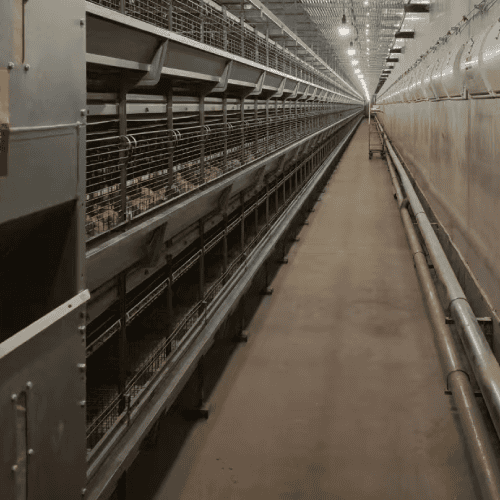
Reviewing a structured operational roadmap for a modern commercial hen farm business plan helps investors visualize physical layout deployment:
- Phase 1 - Infrastructure Construction: Erecting a well-insulated, clear-span steel-structure facility designed for uniform longitudinal airflow and precise temperature regulation.
- Phase 2 - Vertical Cage Installation: Equipping the facility with high-density H-type and A-type layer cages to maximize spatial efficiency and bird comfort.
- Phase 3 - Automation Integration: Installing automated auger feeding lines, nipple drinking systems, and an automatic poultry manure removal system to minimize labor overhead.
3. What Are the Common Challenges in Poultry Farming and How to Address Them?
Direct Answer: The three most critical operational challenges in commercial poultry farming are disease outbreaks, feed price volatility, and high labor overhead. These are successfully resolved through strict biosecurity protocols, waste-reducing automated feeding systems, and mechanized manure scraping solutions.
Every credible business proposal on poultry farming must explicitly analyze these risks and present technological countermeasures:
- Challenge 1: Disease Outbreaks & High Mortality Rates. Uncontrolled pathogens can devastate flock health within hours.
Solution: Implement stringent biosecurity measures, automated tunnel ventilation, and sealed manure belt clearing to eliminate vector breeding grounds. - Challenge 2: Feed Waste & Escalating OpEx. Feed represents 65% to 70% of ongoing operational expenses, making material spillage a major financial threat.
Solution: Deploy precision-engineered automatic feeding systems featuring specialized anti-spill troughs to protect feed conversion ratios (FCR). - Challenge 3: High Labor Overhead. Manual cleaning and manual feeding drive up recurring running costs and introduce human error.
Solution: Automate routine maintenance workflows through integrated mechanical manure scrapers and centralized nipple watering networks.
Expert Pro-Tip: Avoiding Equipment Mismatch
When selecting infrastructure, ensure your ventilation design matches the tier height of your H-type cages. Inadequate static pressure in multi-tier setups can cause uneven micro-climates, directly affecting egg production rates.
Related Poultry Farming Guides & Resources
Financial & Operational Matrix for Poultry Projects
| Operational Element | Financial Impact | Business Plan Optimization Strategy |
|---|---|---|
| Feed Management | 65% - 70% of total OpEx | Controlled via precision automatic feeding systems. |
| Equipment CapEx | Initial setup investment | Long-term durability ensured by H-type & A-type layer cages. |
| Labor & Waste Control | Minimized via automation | Reduced through integrated poultry manure removal systems. |
Frequently Asked Questions (FAQ)
What are the key components of a successful poultry farming business plan?
A successful plan must feature an executive summary, market analysis, technical equipment specifications (such as automatic cages and feeding lines), risk management strategies, and clear financial ROI projections.
Can you provide a sample poultry farming business plan?
Yes, a standard operational sample includes structural steel facility design, H-type or A-type battery cage installation, automated feeding/drinking lines, and precise budgeting to manage feed operational overhead.
What are the common challenges in poultry farming and how to address them?
Core challenges include disease management, feed price volatility, and heavy labor overhead. These are successfully resolved by implementing biosecurity controls, waste-reducing automatic feeding systems, and mechanized manure removal solutions.
Ready to Build Your Professional Poultry Farming Business Plan?
Contact our engineering and project consulting team today for customized farm layout designs, equipment specifications, and comprehensive financial proposals.
Request a Consultation