How to Setup a 20,000 Bird Layer Farm in Indonesia (Climate & Cage Equipment Layout)
Setting up a 20,000 bird layer farm in Indonesia requires careful consideration of the country’s high humidity, intense heat, and heavy rainfall. Proper house dimensions, cage type selection, and tunnel ventilation design are critical to achieving high egg production and low mortality under tropical conditions.
Quick Answer
Under 2026 commercial poultry management protocols, a 20,000 bird layer farm in Indonesia should use a 100m × 15m house with H-type battery cages, tunnel ventilation with cooling pads, and 2.5–3.0 m/s air speed at bird level to handle high humidity and maintain a clean cage environment. This layout delivers the best egg production and lowest operational costs in tropical climates.

Overcoming Indonesia’s High Humidity & Heat Challenges
Indonesia’s tropical climate creates constant high humidity (often 80-90%) and heat stress that significantly reduces egg production and increases disease risk. Without proper ventilation and cooling, layer houses quickly develop high ammonia levels and poor air quality. Tunnel ventilation with cooling pads is now mandatory for any commercial layer farm in the region.
- When relative humidity exceeds 80%, ammonia concentration can rise above 25 ppm, directly causing a 10-15% drop in egg production
- Temperatures above 28°C reduce daily feed intake by 15-20% and increase mortality risk
- Proper tunnel ventilation maintaining 2.5–3.0 m/s air speed at bird level can lower house temperature by 6–10°C even when outside temperature reaches 35°C
- Frequent manure belt operation (2–3 times daily) combined with effective ventilation keeps ammonia below 15 ppm
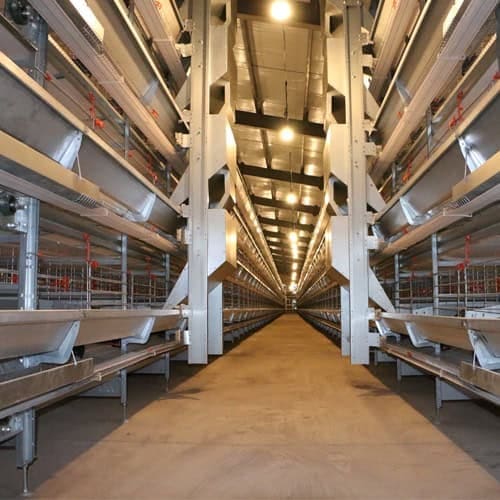
Equipment Selection: A-Type vs. H-Type Battery Cages for Indonesia
H-type cages are the preferred choice for 20,000 bird farms in Indonesia because they offer better airflow, easier manure removal, and higher stocking density while maintaining good bird welfare. A-type cages are more suitable for smaller farms or budget projects but require more careful ventilation design.
Indonesian 20,000 Bird Layer Farm Equipment Specifications
| Parameter | Recommended Specification |
|---|---|
| Cage Type | H-type 4–6 tiers |
| House Dimensions | 100m × 15m (recommended) |
| Ventilation Air Speed | 2.5–3.0 m/s at bird level |
| Cooling Pad Area | 15–18% of house end wall |
| Manure Removal Frequency | 2–3 times daily |
Tunnel Ventilation and Cooling Pad Calibration for Tropical Climates
Tunnel ventilation is the only reliable way to maintain bird-level airflow in Indonesia’s humid conditions. Target static pressure of 18–25 Pa and air speed of 2.5–3.0 m/s at bird level are required to keep house temperature 4–8°C lower than outside air.
Automatic Feeding, Drinking, and Manure Removal Layout
Feeding troughs are fixed at the front of each cage tier at an optimal height to allow birds to reach through the cage mesh while minimizing feed spillage. Proper layout of feeding and drinking lines, combined with frequent manure belt operation, reduces house ammonia by up to 80% and maintains a clean cage environment even during the rainy season.
Conclusion
A well-planned 20,000 bird layer farm in Indonesia requires the right combination of H-type cages, tunnel ventilation, and precise climate control. When correctly implemented, these systems deliver high egg production, low mortality, and fast ROI even in challenging tropical conditions.
Need a Free Customized Indonesian Turnkey Layer Farm Design?
Our engineering team provides complete turnkey design, equipment selection, and layout optimization specifically for Indonesian tropical conditions.
Request Your Free Customized Indonesian Layer Farm Design →
Related Articles
- Why Are My Broilers Panting? (Heat Stress Causes & Tunnel Ventilation Fixes)
- Why Is My Broiler Litter Always Wet? (Main Causes & Fast Solutions)
- Why Did My Broiler FCR Increase Suddenly? (Common Causes & Fast Fixes)
By Caroline, Senior Poultry Equipment Specialist at Weifang Splendid Machinery Equipment Co., Ltd. (18 years global experience in layer systems).
• Global Poultry Automation Trends 2025-2026
• Indonesian Tropical Layer Performance Data
• Field data from commercial layer cage installations in Southeast Asia