How Automatic Harvesting Systems Reduce Bird Damage in Commercial Broiler Cages
Automatic harvesting systems in H-type broiler cages represent a major advancement in reducing bird damage during end-of-cycle evacuation. By using automated sliding floors and soft conveyor belts, these systems minimize manual handling, significantly lowering bruising, wing fractures, and stress-related losses in commercial operations.
Quick Answer
Automated harvesting systems in 2026 H-type broiler cages achieve catching speeds of 8,000–12,000 birds per hour, reduce subcutaneous bruising rates to under 2%, and lower wing/leg fracture rates to less than 0.8%. Full house evacuation for 20,000 birds can be completed in 90–120 minutes with minimal labor, delivering superior meat quality and higher processing premiums.

The Financial Nightmare of Bird Damage During Manual Catching
Manual catching crews cause high rates of wing fractures, leg injuries, and subcutaneous bruising. These defects lead to significant downgrades at the processing plant, reduced carcass yield, and lower market payments. In high-density broiler cages, the physical stress of manual removal further increases mortality and weight loss before slaughter.
Mechanical Breakthrough: How the Sliding Cage Floor Architecture Executes Gentle Drop Layouts
The automated harvesting system uses a motorized sliding floor mechanism that gently pulls back the plastic mesh floor, allowing market-weight broilers to drop smoothly onto a soft longitudinal PP conveyor belt below. This controlled descent eliminates violent catching and minimizes impact trauma to breasts, wings, and legs.
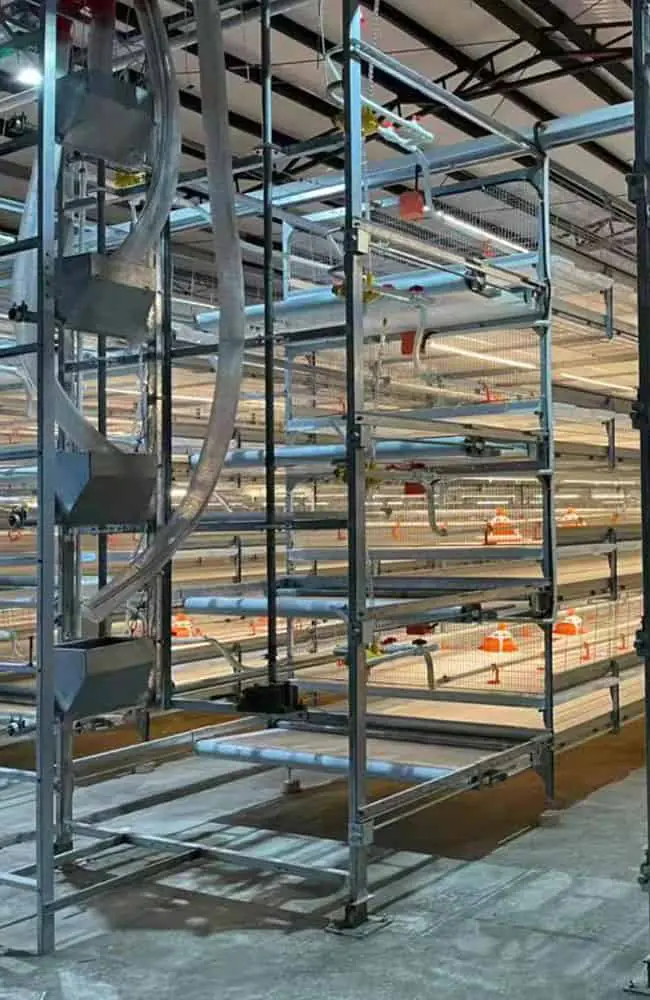
Manual Catching vs. Automated Conveyor Harvesting Mechanical Thresholds
| Metric | Manual Catching | Automated Conveyor Harvesting |
|---|---|---|
| Catching Speed birds/hour | 1,500–2,500 | 8,000–12,000 |
| Subcutaneous Bruising Rate % | 12–25% | 1.5–3% |
| Wing/Leg Fracture % | 4–8% | 0.5–1.2% |
| Labor Required per 20,000 Birds | 12–18 workers | 2–3 operators |
| Full House Evacuation Time | 4–6 hours | 90–120 minutes |
Engineering Alignment: Calibrating Cross-Conveyor Speeds and Elevator Lifts
Precise calibration of cross-conveyor belt speed and elevator lift frequency ensures smooth bird flow without crowding or pile-ups. Matching motor Hz to house length and bird density prevents trauma during transfer to transport crates, maintaining high meat quality throughout the harvesting process.
Financial Return: Evaluating Labor Savings and Processing Premium ROI
Automated harvesting systems dramatically reduce labor costs while improving carcass quality and processing yield. Farms typically recover the investment within 6–10 flocks through higher saleable meat percentages and reduced downgrades, delivering strong long-term ROI in high-density broiler cage operations.
Conclusion
Automatic harvesting systems in commercial broiler cages deliver superior bird welfare and meat quality by replacing stressful manual catching with gentle mechanical processes. The combination of sliding floors and soft conveyor belts significantly reduces damage, labor costs, and processing losses, making them essential for modern high-density broiler production.
Need a Free Turnkey Broiler Cage Layout Design & Equipment Quote?
Our engineering team provides complete turnkey design, automatic harvesting system integration, and equipment optimization for commercial broiler cage farms.
Request Your Free Turnkey Broiler Cage Layout Design & Equipment Quote →
Related Articles
- Calibrating Wind Velocity and Static Pressure in Multi-Tier Broiler Cages (2026)
- Optimizing Broiler Cage Floor Mesh Design to Prevent Breast Blisters (2026)
By Caroline, Senior Poultry Equipment Specialist at Weifang Splendid Machinery Equipment Co., Ltd. (18 years global experience in broiler systems).
• Global Poultry Harvesting Automation Guidelines 2025-2026
• Commercial Broiler Processing Yield Field Reports
• Field data from automated harvesting installations in H-type broiler cages