Egg Collection Belt: Cage or Nest
- An egg collection belt takes the egg off the roll and out of the house. Cage and nest use different belts.
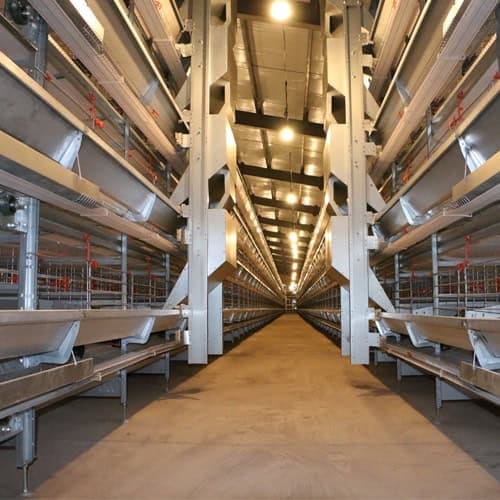
- An H-type layer row has a belt on the front of each tier. A cross conveyor or a table gathers the tiers at one end.
- An automatic nest has one belt, centre or side, to a collection table. Manual nests have no belt.
Weifang Splendid fits the belt to how the egg leaves the bird. On an H-type cage the floor slopes to a belt on the front of the tier. On a floor house the automatic nest rolls the egg onto a belt inside the set. The two belts do not swap. A cage belt is narrow and one per tier. A nest belt is wider and one for the row.
Cage belt
The cage floor is sloped. The egg rolls out, past a wire the hen cannot follow, onto the belt. Each tier has its own loop. At the drive end the belts meet a cross conveyor or a collection head that lifts or turns the eggs to one table. Staff stand at that end. They do not walk the row at lay time.
Belt width on a cage is commonly around 100 mm, polypropylene, about 2 mm thick. Those are shop ranges. The width has to clear the cage front and the guide. Speed is set slow enough that eggs do not pile at the turn. A number off a catalogue is checked against the row length and the tier count you send. An A-type row can take a belt on some builds. Many are still collected by hand from the front. The quote follows the cage, not a default belt.
Nest belt
On an automatic nest the egg rolls off the mat onto a belt in the centre, or onto a side belt. One belt serves the row. It ends at a collection table. The table is where trays are filled, and where a drive and a tensioner sit. A manual nest has no belt. Someone walks the aisle and picks.
Nest belts run wider than cage belts. Community nests commonly use about 250 mm, or a 500 mm belt when two faces share a centre. Cloth or polypropylene, depending on the tray. The mat, the flap that keeps the hen off the belt, and the table are part of the same line. A belt without a clear table end has nowhere for the egg to stop.
| H-type cage | Automatic nest | |
|---|---|---|
| Belts | One per tier, on the front | One for the row, centre or side |
| Width | About 100 mm | About 250 mm, or 500 mm shared |
| Ends at | Cross conveyor or collection head | Collection table |
| No belt | Some A-type rows, collected by hand | Manual nest |
What breaks eggs on the way out
The roll from the floor or the mat should be short. A long drop onto a hard belt edge cracks shells before the belt moves. The turn at the end is the other place. Eggs pile if the cross conveyor is slower than the tier belts, or if the table is not tended in the morning peak. A sagging belt lets eggs ride back or jam in the guide. Tension and a level row fix that. Weifang Splendid marks the drive end and the table before the belt length, because the end is where the egg stops.
What to send
Cage or floor, H-type tiers or automatic nests, row length, and whether eggs stop at a table in the house or go on to a packer. Belt count and width follow that.
FAQ
Does an H-type cage have an egg belt?
Yes. One belt on the front of each tier, gathered at one end.
Does a nest box have an egg belt?
An automatic nest does. One belt to a table. A manual nest is picked by hand.
Are the belts the same?
No. Cage belts are narrow, one per tier. Nest belts are wider, one for the row.
What should I send?
Cage or floor, tiers or nests, row length, and where the egg stops.