Commercial Poultry House Design for Saudi Arabia: Managing Extreme Desert Heat with Tunnel Ventilation
Saudi Arabia’s extreme desert climate presents unique challenges for commercial poultry production. Daytime temperatures regularly exceed 45°C with very low humidity and frequent sandstorms. A properly engineered poultry house must deliver powerful tunnel ventilation, heavy-duty cooling pads, and robust insulation to protect flock performance and maintain profitability.
Quick Answer
For Saudi Arabian commercial poultry farms, the optimal design uses sealed steel-frame houses with 100mm PU sandwich panel insulation, heavy-duty tunnel ventilation fans delivering 3.0–3.5 m/s air speed at bird level, and 150–200mm thick cellulose cooling pads. This combination maintains internal temperatures 8–12°C below ambient even during 45°C+ heatwaves while minimizing power consumption.
The Sand & Heat Challenge: Designing Poultry Infrastructure for Saudi Arabia
Saudi Arabia’s harsh desert environment combines extreme heat, low humidity, and abrasive sandstorms that rapidly degrade standard equipment. High ambient temperatures reduce feed intake, worsen FCR, and increase mortality if ventilation is insufficient. Sand infiltration can clog cooling pads and damage fan motors within months. Only heavy-duty, sand-resistant systems with proper sealing and insulation can deliver consistent performance.
Structural Engineering: Sealed Steel Frame Houses & 100mm PU Insulation
High-density polyurethane sandwich panels (100mm thickness) with reflective outer coating are mandatory to block intense solar radiation. Fully sealed steel-frame construction prevents sand ingress while maintaining structural integrity under high wind loads common in the region.
Desert Climate Poultry House Engineering Thresholds
| Parameter | Recommended Threshold (Saudi Arabia) |
|---|---|
| Target Internal Temp | 24–28°C |
| Target Wind Velocity | 3.0–3.5 m/s at bird level |
| Cooling Pad Thickness | 150–200mm cellulose |
| Static Pressure Range | 20–35 Pa |
| Roof Insulation PU Thickness | 100mm high-density panels |

Tunnel Ventilation Calibration for Maximum Wind-Chill Effect
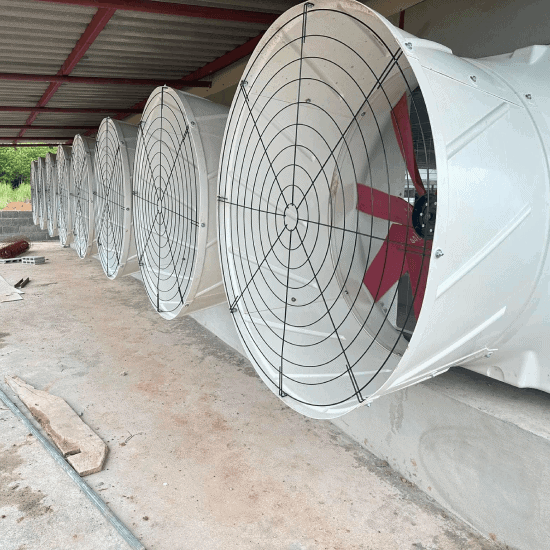
Heavy-duty exhaust fans must generate continuous high-velocity airflow to create effective wind-chill. Target air speed of 3.0–3.5 m/s at bird level is essential in Saudi conditions to keep birds comfortable and maintain feed intake during peak summer heat.
Evaporative Cooling Pad Sizing and Water Quality Control in Desert Regions
150–200mm thick cellulose cooling pads with anti-algae and anti-scale coatings are required to handle extreme dry heat. Proper water filtration and regular maintenance prevent clogging from sand and mineral deposits common in Saudi groundwater.
Conclusion
Successful commercial poultry house design in Saudi Arabia demands heavy-duty tunnel ventilation, thick evaporative cooling pads, and superior insulation to overcome extreme desert heat and sand. When correctly engineered, these systems maintain stable production and deliver strong ROI even under the harshest climatic conditions.
Need a Free Customized Middle East Turnkey Farm Design & Engineering Consultation?
Our engineering team specializes in desert-optimized poultry house design for Saudi Arabia and the GCC region.
Request Your Free Customized Middle East Turnkey Farm Design & Engineering Consultation →
Related Articles
- Tunnel Ventilation System for Poultry Houses
- Evaporative Cooling Pad System for Poultry Houses
- Poultry House Environmental Control System
By Caroline, Senior Poultry Equipment Specialist at Weifang Splendid Machinery Equipment Co., Ltd. (18 years global experience in high-temperature poultry systems).
• Middle East Poultry Infrastructure Engineering Reports 2025
• Gulf Commercial Broiler Performance Data
• Field data from commercial poultry house installations in Saudi Arabia and GCC countries