Tunnel Ventilation System for Poultry Houses
A tunnel ventilation system poultry house is the most effective cooling solution for modern commercial poultry farms in hot climates. It uses high-speed airflow created by large exhaust fans and evaporative cooling pads to lower house temperature by 8–12°C, reduce heat stress, improve feed intake, and boost overall production performance. In 2026, tunnel ventilation poultry house design has become the standard for layer and broiler farms in Nigeria, Saudi Arabia, Philippines, Kenya and other tropical regions.
Quick Answer
A tunnel ventilation system in poultry houses uses powerful exhaust fans and evaporative cooling pads to create high-speed airflow that removes heat and reduces house temperature by 8–12°C. It is the most widely used ventilation system for commercial poultry farms in hot climates.
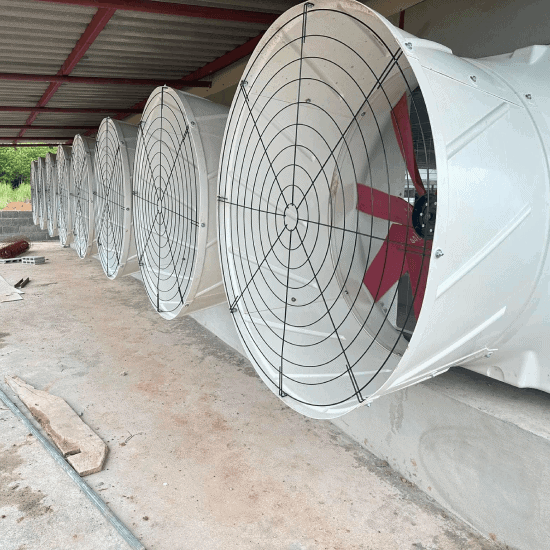
What Is a Tunnel Ventilation System in Poultry Farming
A tunnel ventilation system in poultry farming is a negative-pressure ventilation method that turns the entire poultry house into a long “tunnel.” Large exhaust fans at one end pull air out, while fresh air enters through evaporative cooling pads at the opposite end. This creates a powerful, uniform wind-chill effect that cools birds effectively even when outside temperatures exceed 35°C.
How Tunnel Ventilation Works in a Poultry House
The system works by creating negative pressure inside the house. Exhaust fans remove hot, moist air while drawing cooler outside air through wet cooling pads. As air passes through the pads, water evaporates and absorbs heat, lowering incoming air temperature by 8–12°C. The high air velocity (2.5–3.5 m/s) produces a wind-chill effect that helps birds dissipate body heat, maintain normal feed intake and reduce mortality during heat waves.

Basic Tunnel Ventilation Design Formula
In commercial poultry house design, ventilation capacity is usually calculated based on bird weight and heat production.
- Recommended ventilation rate: 6–8 m³/min per kg of live weight
- Typical tunnel air velocity: 2.5–3.5 m/s
- Fan spacing: 6–10 meters depending on house length
Accurate calculations ensure the ventilation system delivers uniform airflow and prevents hot spots inside the poultry house.
Key Components of a Poultry Tunnel Ventilation System
Exhaust Fans
Large-diameter tunnel fans (usually 1.2–1.5 m) installed at one end of the house provide the driving force. Modern poultry house tunnel ventilation fans are high-efficiency and low-noise, delivering 30,000–50,000 m³/h per fan depending on size.
Cooling Pads
Evaporative cooling pads installed on the inlet end. High-quality cellulose pads offer excellent cooling efficiency and long service life (3–5 years).
Air Inlets
Automatic or manual air inlets that control airflow direction and velocity. Proper inlet design ensures uniform air distribution across the entire house.
Environmental Controllers
Smart controllers automatically adjust fan speed, inlet opening and pad wetting based on temperature, humidity and bird age.
Advantages of Tunnel Ventilation for Commercial Poultry Farms
- Effective temperature reduction of 8–12°C even in extreme heat
- Uniform cooling throughout the entire house
- Higher stocking density possible (up to 15–20% increase)
- Improved feed conversion ratio and egg production
- Lower mortality during summer heat waves
- Better bird comfort and welfare compliance
Recommended Tunnel Ventilation Design for Different Farm Sizes
| Farm Size (birds) | Recommended Fans | Cooling Pad Area (m²) | Air Velocity (m/s) |
|---|---|---|---|
| 10,000–20,000 | 8–12 fans (1.2 m) | 25–40 | 2.5–3.0 |
| 30,000–50,000 | 14–20 fans | 50–70 | 2.8–3.2 |
| 60,000+ | 24–36 fans | 80–120 | 3.0–3.5 |
Tunnel Ventilation vs Natural Ventilation in Poultry Houses
| Aspect | Tunnel Ventilation | Natural Ventilation |
|---|---|---|
| Temperature Control | Excellent (8–12°C drop) | Limited |
| Uniformity | Very high | Low |
| Stocking Density | Higher | Lower |
| Energy Cost | Higher | Lower |
| Best For | Hot climates | Mild climates |
Real Farm Example
A 40,000-layer farm in Kenya installed a complete tunnel ventilation poultry house design in early 2025. During peak summer (outside temperature 38°C), internal house temperature stayed below 28°C. Egg production increased by 9%, mortality dropped from 4.2% to 1.1%, and feed conversion improved significantly. The system paid for itself within 14 months.
Common Mistakes When Installing Tunnel Ventilation
- Undersized fans or cooling pads
- Poor inlet design causing dead zones
- Inadequate maintenance of cooling pads
- Wrong fan placement or insufficient backup power
- Ignoring local climate data when designing airflow
FAQ
Q: How much temperature drop can a tunnel ventilation system poultry house achieve?
A: Typically 8–12°C depending on outside humidity and system design.
Q: Is tunnel ventilation suitable for both layers and broilers?
A: Yes, it works excellently for both when properly designed.
Q: What is the recommended air velocity in a poultry tunnel ventilation system?
A: 2.5–3.5 m/s for optimal cooling and bird comfort.
Q: How often should cooling pads be replaced?
A: High-quality pads usually last 3–5 years with proper maintenance.
Conclusion
A well-designed tunnel ventilation system poultry house is one of the most important investments for commercial farms operating in hot climates. It delivers consistent cooling, higher productivity, better bird welfare, and faster ROI. In 2026, farms that adopt modern poultry tunnel ventilation system design are clearly ahead of the competition.
Need a Professional Tunnel Ventilation System Design?
Our poultry engineering team provides complete tunnel ventilation poultry house design, equipment selection and installation support for farms of all sizes.
Get Your Free Tunnel Ventilation Design & Quote →
Related Articles
- Cooling Pad vs Fogging System for Poultry Houses
- Evaporative Cooling Pad System for Poultry Houses
- Poultry House Environmental Control System
- What Is the Best Ventilation System for Layer Chicken Houses?
By Caroline, Poultry Equipment Specialist, Weifang Splendid Machinery Equipment Co., Ltd.
• USDA Livestock & Poultry Outlook, Feb 2026
• Commercial Poultry Ventilation Reports 2025-2026
• Field performance data from tunnel ventilation installations in hot climates