Modern Chicken Factory Farm: How Automated Equipment Transforms Commercial Poultry Production
Key Takeaways
- Commercial Shift: Modern chicken factory farms replace traditional labor-heavy setups with high-density, automated H-type and A-type cage systems.
- Core Systems: Automation includes intelligent feeding, nipple drinking, automatic manure removal belts, and precise environmental control to optimize the Feed Conversion Ratio (FCR).
- Economic Impact: Upgrading to automated poultry infrastructure significantly lowers operational overhead, minimizes mortality rates, and maximizes long-term investment ROI.
The concept of a chicken factory farm has evolved dramatically over the past few decades. Moving far beyond basic, high-density confinement, modern commercial poultry production relies on precision engineering, advanced automation, and sophisticated environmental control to ensure high productivity and biological safety. For farm investors and operators, transitioning from traditional setups to an optimized factory chicken farming model is the definitive key to scaling profitability and reducing operational risks.
Whether you are designing a new facility or upgrading an existing operation, understanding how automated infrastructure and financial blueprints work is vital for long-term success.
💡 Industry Benchmark Insight:
Modern automated H-type layer cage systems can optimize vertical space utilization by up to 200% compared to traditional flat rearing, while controlling cracked egg rates to under 1%.
1. What Is a Modern Chicken Factory Farm?
In contemporary agriculture, a chicken factory farm (often referred to as a concentrated or intensive poultry production facility) utilizes automated, multi-tier systems to rear large flocks within controlled indoor environments. Unlike backyard or open-range setups, a commercial factory chicken farming operation minimizes external variables like weather, predators, and disease vectors.
The core of these high-efficiency facilities lies in specialized machinery:
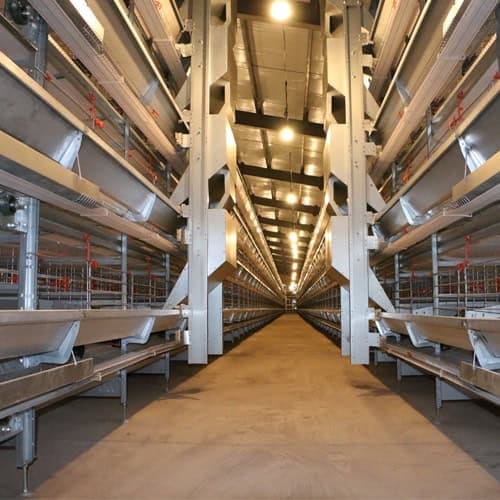
- H-Type Layer Cage Systems: Vertical tier designs that maximize building capacity and floor space efficiency.
- Automated Feeding & Drinking Lines: Deliver precise nutrition and fresh water uniformly across all tiers, preventing feed waste.
- Automated Manure Removal Belts: Continuously clear waste from beneath each tier, maintaining low ammonia levels and superior biosecurity.
2. Traditional Rearing vs. Modern Automated Factory Farming
To understand why commercial investors are shifting toward intensive automated production, it helps to compare traditional methods directly with modern equipment-driven facilities:
| Performance Metric | Traditional Rearing | Modern Automated Factory Farm |
|---|---|---|
| Space Utilization | Low (Single floor, wide footprint) | High (Multi-tier H-type vertical scaling) |
| Labor Requirement | High (Manual feeding & egg collection) | Low (Fully automated systems) |
| Feed Conversion Ratio (FCR) | Higher feed waste due to spillage | Optimized feed delivery, minimized waste |
| Egg Breakage Rate | 2% – 5% | Under 1% (Gentle belt collection) |
3. Core Technical Components of High-Efficiency Poultry Farms
Achieving commercial success in intensive poultry production requires a synergy of structural design and mechanical automation. Below is a breakdown of the essential systems required for a profitable facility:
Environmental Control & Ventilation
Negative pressure ventilation fans and cooling pads work in unison to maintain optimal temperature and humidity, mitigating heat stress and respiratory diseases.
Automated Egg Collection Systems
Gentle collection belts transport eggs from individual cages to a central packing station, drastically cutting down manual labor and structural damage.
⚠️ Engineer’s Warning on Biosecurity
While a dense chicken factory farm maximizes output, neglecting automated manure management or failing to maintain strict negative pressure ventilation can cause ammonia spikes. Ensure your facility is equipped with automated manure scraper systems and continuous air quality monitoring.
4. Maximizing Return on Investment (ROI)
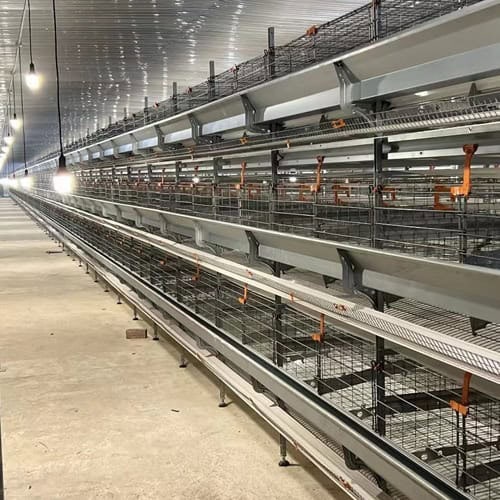
Investing in commercial poultry equipment requires careful financial modeling. By leveraging automated feeding, precise lighting control, and high-density H-type cages, farm owners can systematically reduce the Feed Conversion Ratio (FCR). Lower feed waste combined with reduced daily labor requirements ensures a faster capital payback period for commercial investors.
5. Frequently Asked Questions (FAQ)
Q: What is the main advantage of a modern chicken factory farm over traditional systems?
A: Modern facilities leverage automation (such as H-type cages and auto-feeding lines) to achieve higher stocking densities, lower labor costs, better disease control, and superior feed efficiency.
Q: How do H-type layer cages improve egg production metrics?
A: H-type systems provide structured vertical tiers with integrated egg collection belts that minimize shell breakage, optimize feed access, and streamline daily management.
Q: What equipment is essential for starting a commercial poultry farm?
A: Essential gear includes automated cage systems, feeding and nipple drinking lines, manure removal belts, ventilation fans, and environmental monitoring controllers.
Ready to Build Your Modern Poultry Farm?
Contact our engineering experts today for a custom automated equipment layout and a tailored investment ROI analysis.
Contact Us Now