Poultry Farming Supplies and Equipment: How to Choose the Right System
- Choose equipment by bird type first: layers and broilers do not share the same cage design.
- A complete commercial setup is a system: housing, feeding, drinking, climate control, and manure handling.
- Layer farms typically use A-type or H-type cages; broiler farms use floor systems or broiler cages.
- There is no A-type broiler cage. Do not specify a layer cage for meat birds.
The right poultry farm equipment depends first on whether you are producing eggs or meat, then on housing style, farm scale, and climate. Buy a matched system—not a mix of unrelated chicken supplies.
For a commercial house, the essential package is housing (cages or floor lines), automatic feeding, nipple drinking, ventilation, and manure removal. Weifang Splendid supplies these systems for layer and broiler projects, including H-type and A-type layer cages, broiler cages, and floor-raising lines.
What Counts as Commercial Poultry Farming Supplies?
Retail “chicken care supplies” are not a farm specification. A buyer comparing poultry farming supplies and equipment should look at house-level systems that control feed, water, air, and waste every day.
| System | Why it is essential | Typical equipment |
|---|---|---|
| Housing | Sets density, labor, and bird flow | Layer cages, broiler cages, or floor lines |
| Feeding | Keeps intake uniform and cuts waste | Silo/hopper, chain or pan feeders |
| Drinking | Protects water quality and bird health | Nipple drinkers, regulator, filter |
| Poultry house climate | Holds birds in a workable temperature range | Exhaust fans, cooling pads, controller |
| Manure and collection | Reduces ammonia and daily labor | Manure belts/scrapers; egg belts or nest boxes for layers |
FAO guidance on commercial poultry housing treats large-scale meat production as floor-based houses with litter, and large-scale egg production as cage or controlled-environment houses. That is a planning baseline, not a rule that broilers cannot be caged. Many commercial projects now run broilers on floor lines or in broiler cages, depending on land, labor, and target market.
How to Choose Poultry Rearing Equipment
If you are asking “how do I choose the right equipment for poultry rearing?”, answer four questions before you request a quotation.
- Bird type: layers or broilers.
- Housing style: cage or floor.
- Scale: house length, bird number, and whether you will expand.
- Climate and power: hot-climate tunnel ventilation needs a different fan and pad package than a mild, open-sided house.
Do not start from a generic “poultry equipment” price. A layer cage quotation and a broiler cage quotation are different bills of materials: floor mesh, trough design, bird movement, and manure layout are not interchangeable.
Layer farms: A-type cages, H-type cages, or floor
Commercial egg farms most often choose a layer cage system because eggs can roll out, manure can be separated from the birds, and collection can be mechanized. Floor layer houses still work, but they need nest boxes and more walking labor.
An H-type layer cage system is a stacked, corridor-style layout. It is usually selected when the farm wants higher birds per building footprint and more automation on feeding, drinking, manure belts, and egg collection.
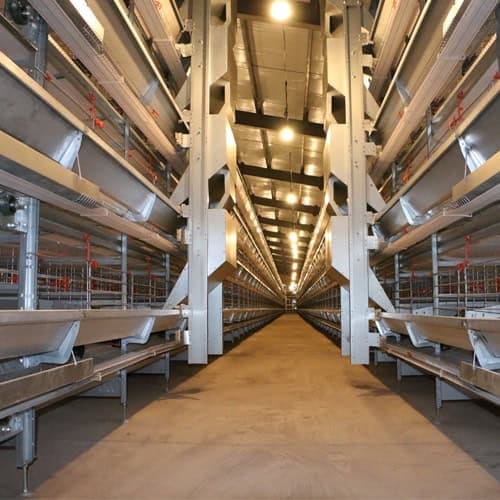
An A-type layer cage system uses a stepped frame. It is a common choice for small and mid-size layer houses where the buyer wants a simpler structure and easier visual inspection of birds. It is a layer product. It is not a broiler cage option.
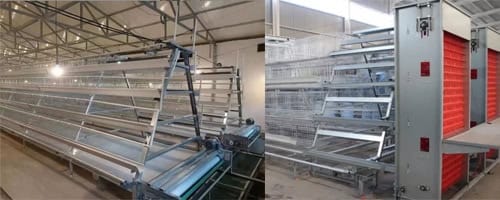
Broiler farms: floor raising or broiler cages
Broiler chicken equipment follows a different logic. Birds are grown to a slaughter weight in a short cycle. You need fast catching, enough feeder and drinker access, and a house that can be cleaned between flocks.
Floor raising remains the most widely used broiler model. A typical commercial line uses pan feeders plus nipple drinkers on litter. This is still the default in many markets because placement, growth, and harvest are straightforward when litter management is under control.
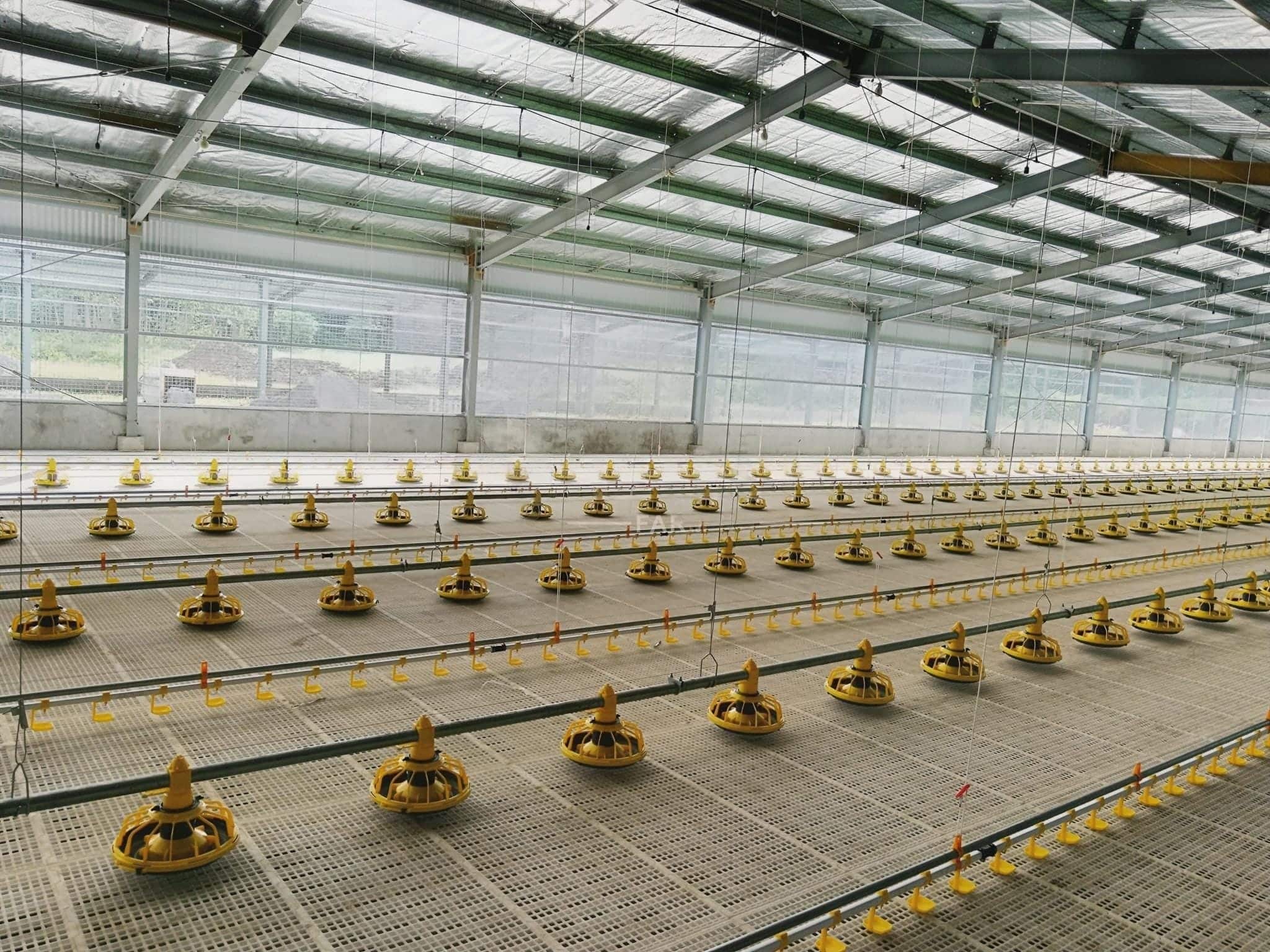
Broilers can also be reared in cages. A broiler cage is built for growth and harvest, not for egg roll-out. Manual broiler cages are used where labor is available and automation can be added later. Automatic broiler cages add feed lines and manure belts. There is no A-type broiler cage in standard commercial supply.
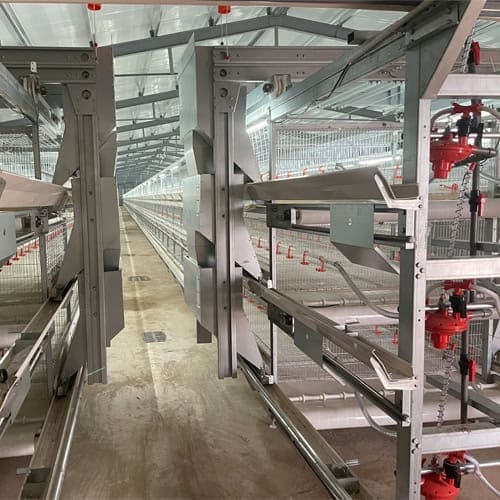
Quick Comparison: Which Poultry House Equipment Fits?
| Option | Best for | Do not use for |
|---|---|---|
| H-type layer cage | Larger egg farms that want stacked density and automation | Broiler grow-out |
| A-type layer cage | Smaller or mid-size layer houses | Broilers. No A-type broiler cage |
| Broiler cage | Meat farms that want birds off litter | Laying hens |
| Broiler floor line | Standard commercial broiler houses | High-density cage-layer programs |
Essential Supplies for Starting a Poultry Farm
The essential supplies for starting a poultry farm are the systems that must work on day one. Optional items can wait; core house equipment cannot.
Must specify before installation
- Housing system matched to layers or broilers
- Feed storage and in-house distribution
- Closed drinking line with nipples and pressure control
- Exhaust fans and, in hot climates, cooling pads
- Manure removal method that matches the housing system
- For layers: egg collection path (belt or nest box)
- For broilers: catching and crate flow at harvest
Can be staged later, depending on budget
- Higher automation on manure and egg belts
- Weighing and silo sensors
- Central environment controller upgrades
Chicken crates belong on a broiler packing list because harvest is part of the production cycle. They are not a substitute for house equipment.
Poultry House Equipment You Should Not Treat as Optional
Cages and feed lines fail in a hot house if air movement is wrong. Poultry house equipment therefore includes climate hardware, not only the rearing structure.
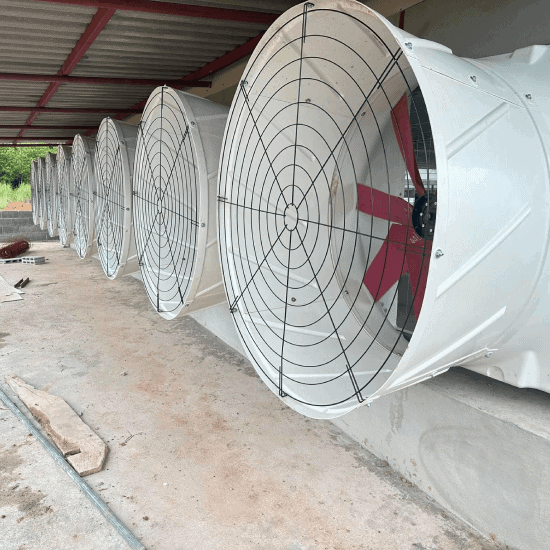
In warm regions, a common commercial package is negative-pressure tunnel ventilation: exhaust fans on one gable, cooling pads on the opposite end, and a controller that holds target temperature. Exact fan count depends on house width, length, insulation, and local design temperature. That calculation should come from the house drawing, not from a copied quote for a different building.
A Practical Buying Sequence
Step 1. Lock bird type and target capacity per house.
Step 2. Choose housing: layer A-type, layer H-type, broiler floor, or broiler cage.
Step 3. Match feeding and drinking to that housing. Pans belong on broiler floor lines; troughs or cage feeders belong on cage rows.
Step 4. Size ventilation to the finished house, including heat load from birds and equipment.
Step 5. Add manure, egg, or harvest equipment so daily work has a clear path.
Step 6. Request one quotation for the full package, not separate prices that ignore installation layout.
The expensive mistake is mixing catalogs. A layer A-type cage is built for hens and eggs. A broiler cage is built for grow-out. A floor pan line is built for litter houses. If the drawing says one system and the purchase order says another, installation quality will not save the project.
FAQ
What poultry farm equipment do I need to start?
Start with housing, feeding, drinking, ventilation, and manure handling. Add egg collection for layers and harvest crates for broilers. That list is the commercial core; retail accessories are not.
How do I choose equipment for poultry rearing?
Choose by bird type, then housing style, then scale and climate. Only after those four points should you compare automation level and price.
Can broilers be raised in cages?
Yes. Broilers can be raised on the floor or in broiler cages. Floor systems with pan feeding are still common. Broiler cages are a separate product from layer cages, and there is no A-type broiler cage.
Is poultry farm equipment the same as chicken farming supplies?
In commercial search, buyers often use both phrases. For a factory farm they mean house systems: cages or floor lines, feeders, drinkers, fans, and manure equipment. They do not mean backyard chicken products.
Need a matched equipment list for your house?
Send bird type, capacity, and climate. Weifang Splendid will map layer or broiler equipment to your drawing.