Poultry Transport Crates by Bird: Broiler Catch and Spent Hens
- A poultry transport crate is filled at catch, stacked on the truck, and emptied at the plant.
- Market broilers and spent hens use the same crate body. Live weight decides how many birds go in.
- Weifang Splendid cuts the order from bird type, catch weight, birds per crate, and truck deck height.
The crate has to hold a live bird for the haul, stack without crushing the layer below, and still pass air while the truck is moving or waiting. Door, latch, slots, floor and stack feet are the parts that decide whether that load arrives fit to hang.
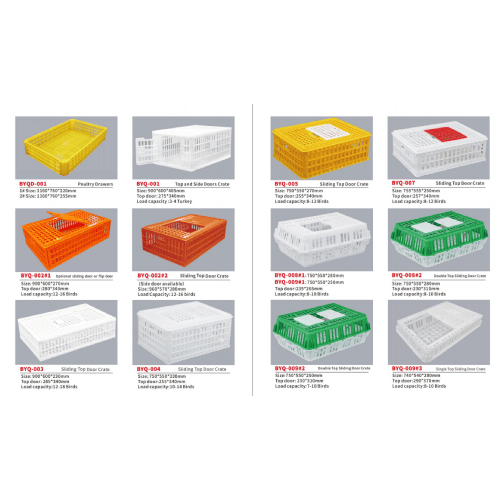
What the crate is built to do
The body is plastic, so it can be washed and sent back for the next catch. The door has to open with one hand in a dark aisle and stay shut on a rough road. The latch takes the knock of stacking, not a padlock. Slots on the sides and ends pass air through a full stack. A solid wall holds heat once crates sit loaded in the yard. The floor wants a surface that does not cut feet and a lip that keeps manure in the crate rather than on the crate below. Feet and top rim have to register, so a stack of eight does not walk sideways on the first corner.
Empty crates stack tighter than full ones. The yard needs space for both: full stacks waiting for the truck, empty stacks coming back from the plant. A crate that only stacks when it is full wastes the return trip.
Which bird goes in, and how full
One crate body covers the two loads most farms actually ship. The fill changes.
| Load | How the crate is filled |
|---|---|
| Market broiler | Heavier bird. Fewer per crate. Catch weight, not day-old size, sets the count. A 2 kg bird and a 3 kg bird do not take the same fill. |
| Spent hen | Lighter than a finished broiler. More birds per crate, still with headroom so the door closes on feathers, not on backs. |
| Mixed cull on the same night | Keep broiler crates and hen crates in separate stacks. One average count for both loads overfills the heavy bird. |
Birds per crate are not printed here. Send the live weight at catch and the count you already run. That pair fixes the order. A crate packed for a chick count will not take a finished broiler.
Floor catch and cage catch
On a floor house the crew works the litter and fills crates in the aisle, then slides full crates to the door. On a cage row the bird comes off the tier into the same crate. The truck sees a stack either way. Cage catch is slower per bird if the door of the crate and the door of the tier fight each other in a narrow aisle, so crate width matters as much as truck height.

How many crates a night needs
Count full crates from birds leaving that night divided by birds per crate, then add a spare stack. Latches break, a crate comes back cracked, and the last house often runs long. Empty crates have to be in the house before the crew starts. A truck that arrives to find the stack still in the yard is a catch that slips.
| Check before the order | What it changes |
|---|---|
| Bird and catch weight | Broiler or spent hen, and kilograms at the door |
| Birds per crate | The count the crew already uses, or the count you want to set |
| Birds leaving in one night | Sets full crates, plus spare |
| Truck deck height | How high the stack may go |
| Aisle width | Cage houses need the crate to pass the tier door |
| Wash | Crates return. They have to wash and stack empty. |
What to send
Bird type, live weight at catch, birds per crate, birds leaving in one night, truck deck height, and floor or cage. Climate matters if loaded crates sit before the truck moves. Weifang Splendid marks the crate count from those figures.
FAQ
Which birds use this transport crate?
Market broilers and spent hens. The body is the same. Live weight sets how many go in.
How many birds go in one crate?
From catch weight and the count you send. A finished broiler does not take a chick fill.
Floor house or cage house?
Both fill the same crate. Cage aisles also need the crate to pass the tier door.
What should I send for a crate list?
Bird type, catch weight, birds per crate, night total, deck height, floor or cage.
Send catch weight and the night total.
Broiler or spent hen, birds per crate, deck height, floor or cage.