2026 Automatic Chain Feeding Lines: 75% Labor Savings & Feed Efficiency Guide
Looking for a proven way to slash labor costs and dramatically improve feed efficiency in your layer or broiler operation? Automatic chain feeding lines deliver one of the highest-ROI upgrades available in 2026. Farms using well-designed systems consistently report 75–82% labor reduction and 12–18% lower feed waste compared to manual or pan feeding.
The Current Reality: Labor and Feed Waste Still Kill Profits
Feeding accounts for 60–70% of daily labor on most commercial poultry farms. Manual feeding also causes inconsistent distribution and 8–15% feed waste. For a 20,000-bird farm, this easily translates to $15,000–25,000 in annual losses.
How Automatic Chain Feeding Lines Work
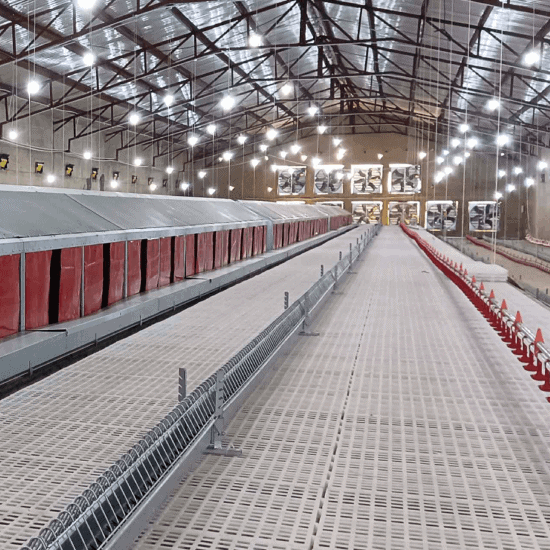
A chain feeding line uses a continuous loop of high-strength chain that pulls feed from a hopper. The system runs on timers or sensors, delivering precise amounts of feed to every bird at the same time. Key advantages include uniform distribution, reduced selective feeding, minimal spillage, and easy maintenance.

Real ROI Comparison: Chain Feeding vs Traditional Methods
| Metric | Manual Feeding | Pan System | Chain Feeding Line |
|---|---|---|---|
| Labor Hours per Day | High (4–6 workers) | Medium | Very Low (1 supervisor) |
| Feed Waste Rate | 12–18% | 8–12% | 2–4% |
| 5-Year Total Cost | Highest | Medium | Lowest (20%+ savings) |
| Payback Period | N/A | 18–24 months | 9–13 months |
Implementation Roadmap: How to Successfully Install Chain Feeding Lines
- Phase 1: Assessment (Week 1) – Calculate daily feed consumption and current labor cost
- Phase 2: System Selection (Week 2–3) – Choose chain speed, pan spacing, and hopper size
- Phase 3: Installation & Training (Week 4–6) – Complete installation in 4–6 weeks
- Phase 4: Optimization (Month 2–3) – Fine-tune timers and monitor FCR improvements
Practical Checklist Before You Buy
- High-strength galvanized steel chain
- Anti-bridging hopper design
- Readily available spare parts
- Installation drawings and on-site training
- Easy integration with existing water lines
FAQ
Q: How much labor can I really save?
A: Most farms achieve 75–82% reduction. A 20,000-bird house often drops from 4 workers to 1 supervisor.
Q: Is chain feeding suitable for both layers and broilers?
A: Yes, with different pan designs and chain speeds optimized for each type.
Q: What is the typical payback period?
A: 9–13 months for most commercial farms.
Q: How do I maintain the system?
A: Weekly visual checks and annual deep cleaning. Spare parts are inexpensive and fast to ship.
By Caroline, Senior Poultry Equipment Specialist at Weifang Splendid Machinery Equipment Co., Ltd. (18 years global experience in broiler & layer systems, has helped 200+ farms in Nigeria, Saudi Arabia, Philippines and Kenya).
• Commercial Poultry Feeding Reports 2025-2026
• Field performance data from chain feeding installations worldwide
• USDA Livestock & Poultry Outlook, Feb 2026
Also read: Broiler Ground System Equipment | Layer & Broiler Cage Systems | Global Project Cases